Angered by this comment, Al-Miqdam decided to confront Muawiyah regarding the forbidden items in his house, asking him to confirm the prohibitions by Allah.
This hadith recounts a tense exchange between the companion and the Caliph Mu'awiyah bin Abi Sufyan . The encounter highlights two major themes: the status of the household of the Prophet (Ahl al-Bayt) and strict adherence to the Prophet's prohibitions on luxury items.
. In this narration, Al-Miqdam censures Mu'awiyah for having items in his home that the Prophet Muhammad (ﷺ) had prohibited. Sunnah.com Hadith Text Summary According to Sunnah.com , the narration includes the following key points: Announcement of Death: Mu'awiyah informs Al-Miqdam of the death of Al-Hasan ibn Ali
I understand you're asking me to develop a feature based on "abu dawood 4131 fixed" — likely referring to , hadith number 4131 , and you want to implement something related to its "fixed" or authenticated status.
In many poorly translated transcripts or polemical narratives, the statement that Al-Hasan was "a live coal that Allah extinguished" is wrongly blamed on Mu'awiyah himself. The "fixed" and accurate text clearly states this insult came from a —a sycophantic courtier trying to please the ruler. 2. Mu'awiyah's Response to Al-Miqdam abu dawood 4131 fixed
Al-Miqdam challenges Mu'awiyah to confirm if he heard the Prophet (ﷺ) forbid specific items. Mu'awiyah admits the Prophet (ﷺ) prohibited: Using or riding on the skins of beasts of prey (specifically leopard skins). The Accusation:
The man followed the order, gathered firewood, sold it, and returned having earned ten dirhams.
The majority of Islamic legal schools rule that the pelts of non-halal predatory animals do not become entirely pure ( Tahir ) for prayer purposes, even after undergoing the traditional chemical tanning process ( Dibagh ). The Broader Historical Context
: Al-Miqdam visited Mu'awiyah and challenged him on several practices that the Prophet Muhammad (ﷺ) had prohibited. Prohibited Items Mentioned : Wearing gold . Wearing silk . Angered by this comment, Al-Miqdam decided to confront
The use of (such as leopard skins) for clothing or riding.Mu'awiyah acknowledges these are forbidden but admits they are present in his house. Scholarly Grading and the "Fixed" Context
The prohibition of gold and silk for men is reinforced across multiple canonical books, including Sahih Bukhari and Sahih Muslim. The underlying wisdom ( Hikmah ) is to safeguard men from excessive vanity, arrogance, and the soft, decadent lifestyles that lead to societal decline. Women are explicitly exempted from these two restrictions to accommodate natural expressions of adornment. 2. The Ban on Predatory Skins and Leopards
A man present asked him: "Do you consider it a calamity?" He replied: "Why should I not consider it a calamity when the Messenger of Allah (ﷺ) placed him in his lap and said, 'This one is from me, and Husayn is from Ali'?" The man from Banu Asad then remarked: "He was a live coal (fitnah) which Allah has extinguished."
The Prophet (ﷺ) said: (Sunan Abu Dawood 4131, Sahih according to Al-Albani) 'This one is from me
Tadlis is a technical term in hadith science that refers to a narrator concealing the identity of their source. This could involve mentioning a teacher by a less-known name, or narrating directly from a teacher they never actually met, obscuring a potential break in the chain. Because of this practice, many classical and modern hadith scholars are cautious about accepting narrations from Baqiyyah unless he explicitly states that he heard the hadith directly.
When researchers and web developers look for a "fixed" version of this hadith, they are usually addressing three distinct issues: 1. Digital Numbering Mismatches (The Indexing "Fix")
The Prophet (ﷺ) ordered him to bring these items. He then sold them for two dirhams.
|
|
We've been asked to put the whole Holy Bible in the site.. so here it is.. You could save it, print it, or copy any verses from it.. Now available in English Bible, Arabic Bible, Portuguese Bible and Amharic Bible. For Arabic Bible Search click here.
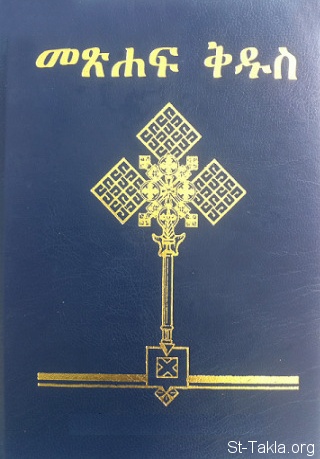
This Biblica translation of the Bible is for the Amharic language, which is primarily used in Ethiopia. This translation uses an informal language style and applies a meaning-based translation philosophy. It is translated from the biblical languages. The Old Testament was completed in 2001 and the New Testament in 1988.
Original source
and copyright are available through each file's properties.
Abu Dawood 4131 Fixed Upd Jun 2026 |
Abu Dawood 4131 Fixed Upd Jun 2026 |
|
Genesis |
Matthew |
Read the Holy Bible in these languages:
Bible | Daily Readings | Agbeya | Books | Lyrics | Gallery | Media | Links
https://st-takla.org/Bibles/Holy-Bible-Amharic.html
Short URL (link):
tak.la/w6875sd